Sisters arrive from Jejudo, South Korea

Our Sisters Monica and Paulina from their community on the beautiful Island of Jeju have come to the Midwest of the United States to be with us. What joy they bring to community. In the 1960’s Archbishop Henry, a Columban Missionary, serving the diocese of Quanju, but originally from Northfield, Mn, invited the Minneapolis Clares to begin the first Poor Clare Community in Korea. Young women came to the monastery here for studies and returned in 1970 with a group of Koreans and Americans to begin life on the Island. Forty-years later there are 6 monasteries of Poor Sisters of St. Clare in Korea.
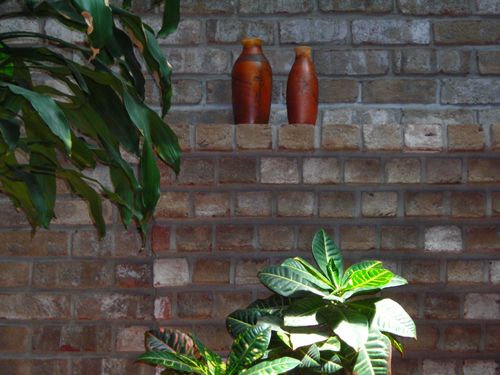
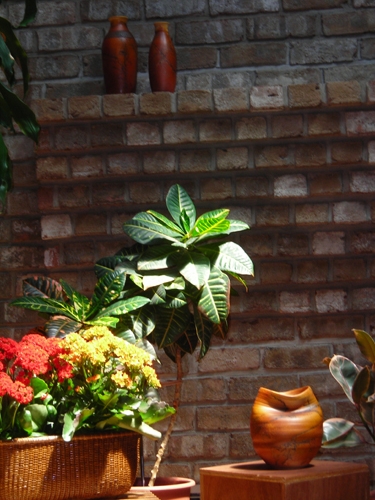
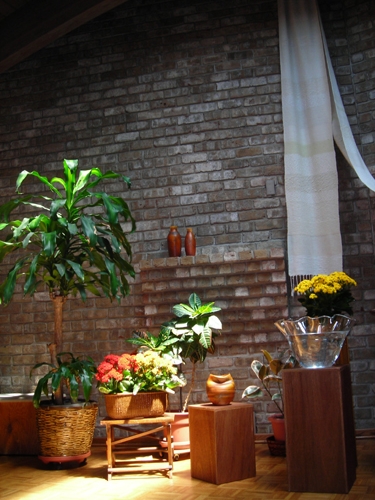
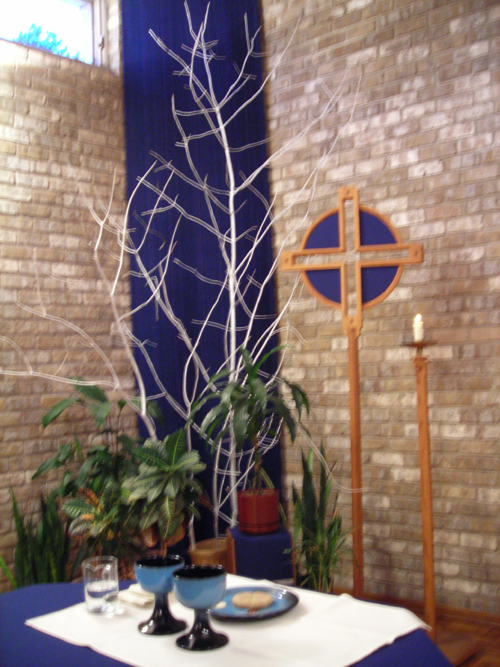
Plants look so lovely with the bright Kalanchos.
Pots and plants, sun kissed through the the Chapel skylight,
Share the joy of Easter.
Dear friends,
From the water of our baptismal renewal to the altar of communion in our Lord, we are called together as God’s people. Born from the Water, entering into the Light, we celebrate in Joy the Resurrection.
This year, 2012, has an added luster. It is the 800th anniversary of the first community of poor sisters and lesser brothers at the church of San Damiano outside the walls of Assisi, Italy. We remember particularly Clare and her companions who opened up a new path of ministry, service and prayer for women as partners in a world needing care, mutual respect and reverence. Faced with misunderstanding, Clare lived her life with quiet conviction which resonates in the “form of life of the poor sisters which the blessed Francis founded” and a small corpus of writings attributed to the poor sisters and lesser brothers who lived gospel community there at San Damiano from 1212-1255.
In 1225 at San Damiano Clare nursed Francis who was suffering from an illness of the eyes. During this period, the nearly blind Francis composed the Canticle of the Creatures, the song praising God through all creation from the cosmic to the incarnational, calling for peace between the bishop and the mayor, and in the last stanza of the song, welcoming Sister Death as she leads us home to God.
“Praised be you, my Lord, through all your creatures,” and that includes us all,
your Sisters
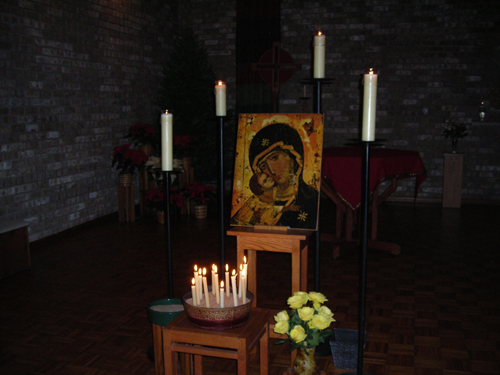
Our Lady of Vladimir led us into the New Year.
Our Lady of Vladimir led us into the New Year.
You were all included in our prayer last evening as we brought the year, 2011, to a close. You were with us in silence, in song and in chanting. As our Sister Clare of Assisi urges us, let us go forth now in peace entering into this new year, each one of us blest by the Lord, the good guide who has created us, sustains and will be faithful throughout this New Year of 2012. Your Sisters
Those dear bells…
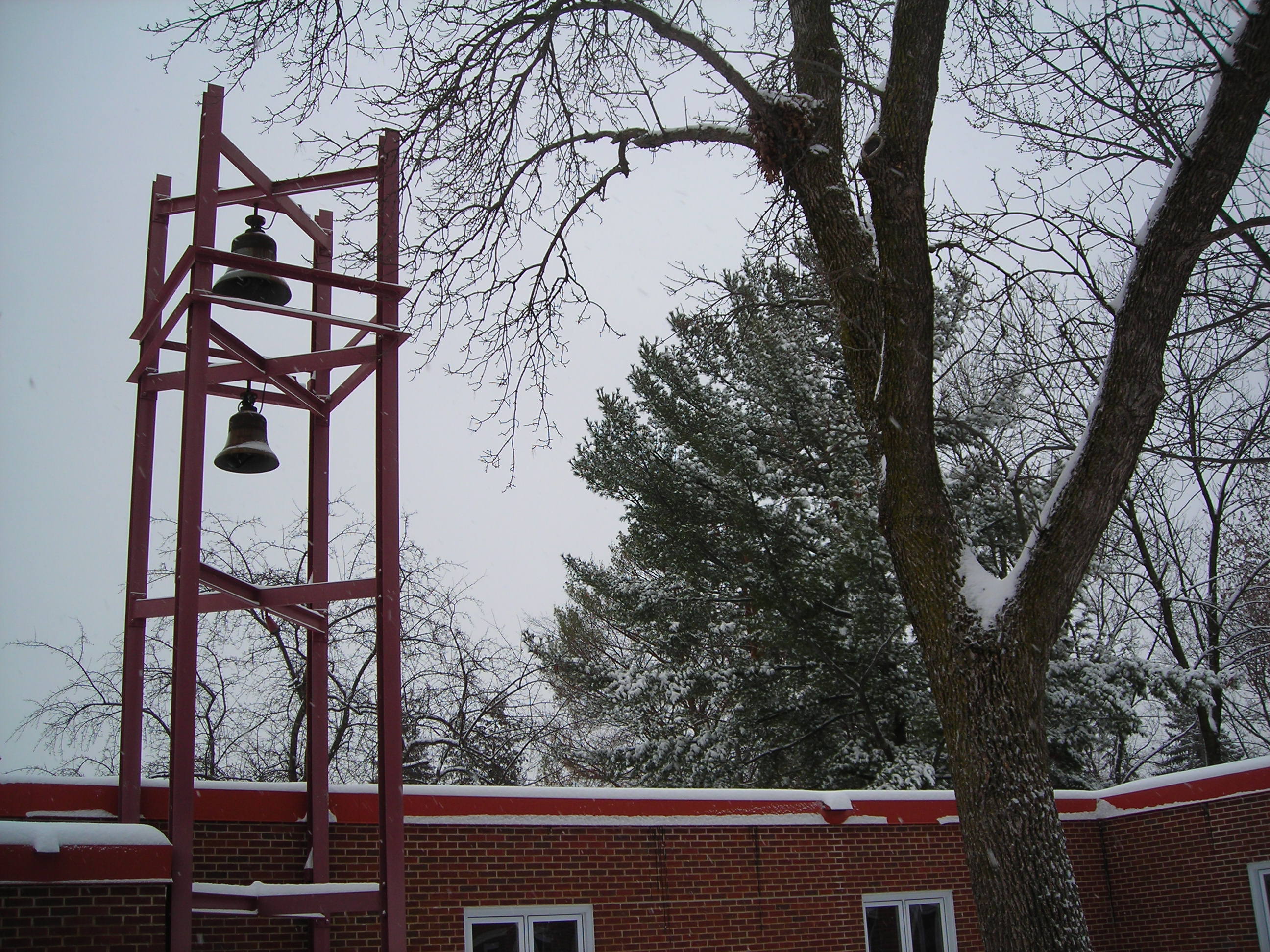
How dear those bells whose voices
tell the Savior’s birth!
Let our hearts sing as well
to praise His coming to our needy earth.
With our Christmas greetings and prayer,
your Poor Clare Sisters
The Story of the Bells
What is it about the sound of bells, particularly Church bells, that is so intriguing? Bells are a communal experience. They invade public auditory space shared with horns and sirens and birds. Each has a parcel of sounds communicating a public message to the world at large. These communitarian sounds call for a response, as did the town crier in days gone by.
Bells are not only outside ourselves but seem to resonate within, awakening a place of longing, a remembered feeling, the home of our soul. They call us to reflection, and reception of a personal inner message that strikes our hearts with fear or sadness or a tingle of hope. Bells ringing in a neighborhood evoke the question, “What are those bells?”
We came to this south Minneapolis neighborhood in 1954. The bells arrived 11 years later, a gift of the Pendergast family. They were blessed and baptized by Bishop Cowley, associate Bishop of the Archdiocese of Minneapolis/St. Paul. Named for the donors, Raymond, the larger bell has a diameter of 29 ¾ “, weighs 583 lbs and strikes the musical tone “C.” Pauline’s diameter is 23 ¾”, weighs 290 pounds and sounds the “E” tone.
Our bells here at the monastery ring seven times a day, each time sounding a call to prayer. The longer ring remind us of the prayer of the Angel announcing the Incarnation of Christ, the shorter ring calls us to the Liturgy of the Hours prayed 5 times a day here at the monastery, and by individuals and communities throughout the world. Most neighbors like to hear the bells except at 6:00 in the early morning. That early ringing was terminated within the first week of the installation of our bells.
This Advent/Christmas season, when you hear the bells, remember they ring for you, with our promise of prayer now and in the coming year.
your Sisters of St. Clare
Some thoughts about the Franciscans
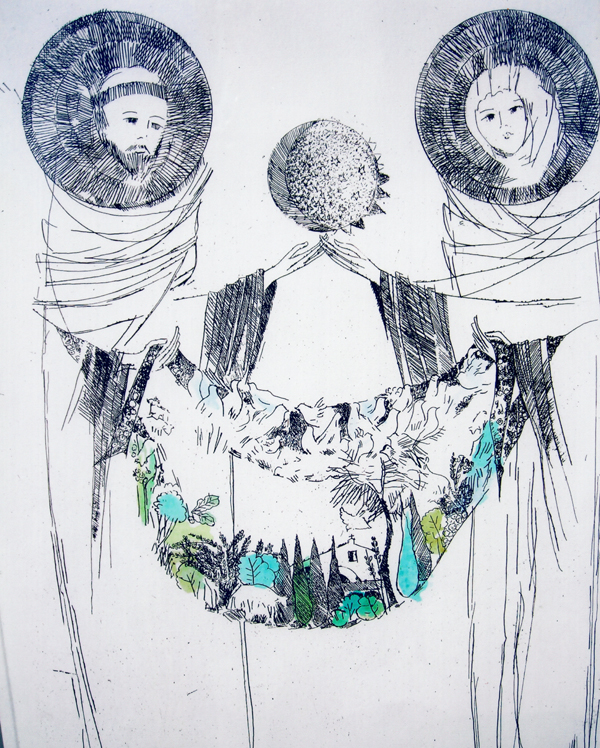
Marisa Picelli is the author of this drawing of Clare and Francis with the animals and birds at the church of San Damiano. I think of Clare and Francis as a type of Adam and Eve, and the animals and birds as representing all of creation. In the center is a symbol of the Trinity: the Sun giving light to the Moon, and the Stars radiating throughout the universe. This beautiful image was brought to us from the Gallery of the Song of San Damiano in Assisi.
Clare and global ecology
Clare and Francis of Assisi and the lesser brothers and poor sisters can never be separated from God’s holy people. As we look back in time to 13th century Assisi, we see a creative energy and lightsomeness moving among God’s people. This was not just in Italy but west to the British Isles and to the east, to the countries of the Levant.
Eight hundred years later there was another moment of light and energy.
How can we explain to young people today what happened in the Sixties? There was a global movement among the young people of the world. Part of that global movement was a Christian enlightenment, a high point being the Vatican II Ecumenical Council.
Both the Franciscans of the 13th century and Christians at the time of the Vatican Council looked to the first Christian era and the Scriptures containing the stories of Jesus of Nazareth and the activities of the first Christians. When reading the Christian Scriptures they realized that what Jesus read and prayed in Synagogue were the Hebrew Scriptures. The prayer of the Our Father was in the Aramaic.
My point here is that globalization and ecology are not simply a study of matter, but also include the spiritual history of our planet and truly of the cosmos. We need to look at moments of spiritual enthusiasm that contribute to the passionate research of the spiritual dimension of humanity and all created matter, matter and spirit together. Teihard de Charden is a modern example of a person who lived and taught this double endeavor. We need both scientfic research and living expressions of spiritual traditions.
In what sense then can Clare of Assisi contribute to Ecology? “Eco,” oikos comes from the Greek meaning “house.” And of course, logy is the “study of.” House is a meaning- laden term. Open a good dictionary and you will find how broad and inclusive is the concept of “a house.”
In October, 2009, working with Dr. Jean Moleski-Poz and Friar William Short, OFM in preparation for the first Clarian retreat at the Franciscan Center, San Juan Bautista, CA, the theme that emerged immediately without any hesitation on the part of the four of us so engaged in the retreat preparation was: “The House of Clare.”
In 1212 Frances and the brothers welcomed Clare and her sisters to San Damiano. The charism of the Franciscan family was born. In 1224 at San Damiano, suffering from a disease of the eyes, Francis composed the “Canticle of the Creatures: Praise to you, Brother Sun…Sister Moon and all the creatures…” Francis, who never had blood sisters, learned what it was to have a sister from Clare. We all need one another. We are all inter connected, both materially and spiritually. Is that not we learn from ecology?
Those of you who know the early writings and traditions of the Franciscans are aware of the focus of the early brothers and sisters on poverty. Strange? Maybe not. According to the tradition Clare fought for the “privilege” of living in community without dowries, and income generating property. The Clares were not independently weathy. The key word is “independent.” They needed the friars and God’s people. Their world was deliciously interdependent.
Beth Lynn, OSC
A VISIT FROM AFAR
A VISIT FROM AFAR
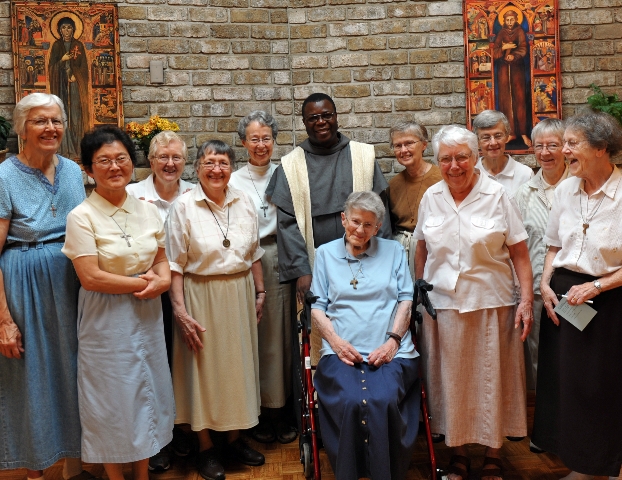 Father Patrick Chisanga, OFM, Conv. visits us from Zambia. He is the newly elected minister of the Zambian Province of the African Martyrs.
Eucharist on Saturday morning, August 27, 2011.
Good morning, friends,
Please note the change of time for Eucharist on Saturday, August 27, 2011. Fr. Kevin McDonough will preside at 7:30 am.
We hope that you can join us.
Your Sisters at St. Clare’s
The Chapel is ready for the Feast.
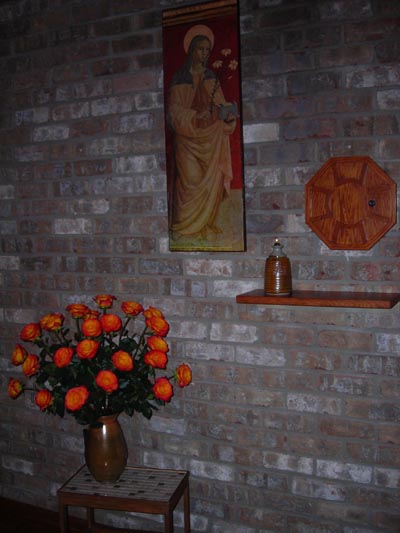
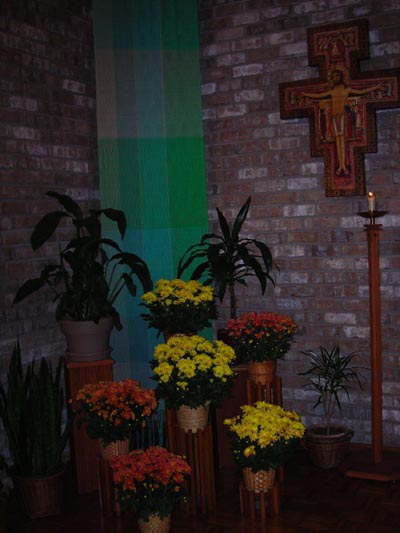
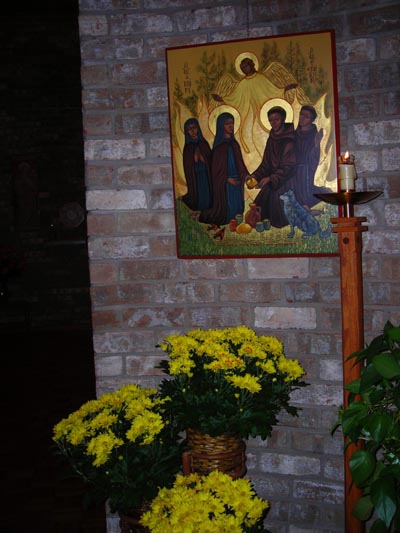 Some views around the Chapel for the feast.